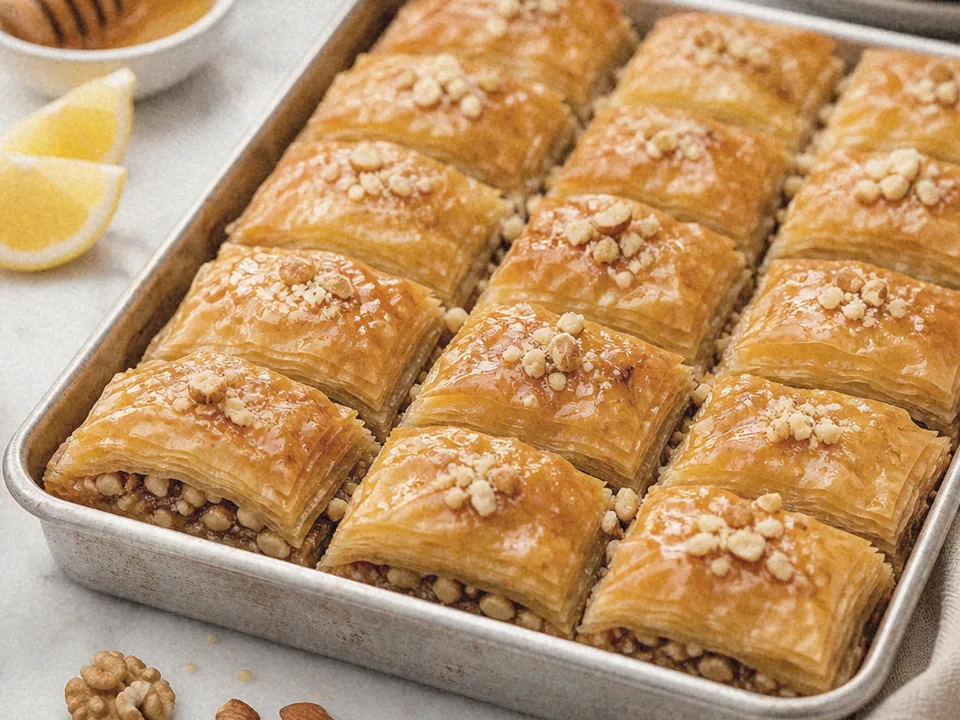
Almond, Walnut and Honey Baklava
Layers of golden filo pastry, an almond and walnut filling lightly scented with cinnamon, and a lemon honey syrup poured cold over the hot baklava. For a 20 × 15 cm metal baking pan, making 12 small portions. Allow 3 hours of uncovered resting time after baking; the syrup cools while you prepare and bake the baklava.
Ingredients serves 12
- 🥐Filo pastry, thawed and trimmed to fit the pan120 g
- 🌰Plain almonds100 g
- 🌰Shelled walnuts100 g
- 🧈Unsalted butter80 g
- 🤎Ground cinnamon1 g
- 🍯Honey140 g
- 💧Water80 ml
- 🍋Lemon juice15 ml
Steps
Combine 140 g honey, 80 ml water and 15 ml lemon juice in a small saucepan. Heat for about 3 minutes until simmering, then simmer gently for 5 minutes, without trying to thicken the syrup too much. Meanwhile, melt 80 g butter over very low heat in another small saucepan for about 4 minutes. Chop the 100 g almonds and 100 g walnuts into small pieces measuring 2 to 4 mm, without grinding them to a powder.
Remove the syrup made with 140 g honey, 80 ml water and 15 ml lemon juice from the heat and leave to cool uncovered for about 90 minutes, until it reaches room temperature; continue with the following steps while it cools. In a dry frying pan, toast the 100 g chopped almonds and 100 g chopped walnuts over medium-low heat for 6 minutes, stirring often: they should smell fragrant without browning too much. Spread on a plate, leave to cool for 10 minutes, then mix with 1 g cinnamon.
Preheat the oven to 170 °C, conventional heat, for about 15 minutes. Meanwhile, assemble the baklava in a 20 × 15 cm metal baking pan: brush the bottom and sides with 5 g of the 80 g melted butter. Divide the 120 g filo pastry into three equal batches of 40 g, each making about 6 layers depending on the thickness of the pastry. Keep the unused sheets under a barely damp cloth. Stack the first 40 g batch, brushing each layer very lightly with butter, then spread over half the mixture made with 100 g almonds, 100 g walnuts and 1 g cinnamon. Add the second 40 g batch of buttered filo, then the remaining filling. Finish with the last 40 g filo. Use the remaining 75 g butter for all the layers and the top. Small trimmings can be used to fill out the inner layers; save the intact sheets for the top.
Using a sharp knife, cut the assembled baklava into 12 rectangles, cutting through all the layers to the bottom. Place on a rack in the lower third of the oven and bake for about 50 minutes. The top should be deeply golden and the lower layers fully cooked: gently lift a corner with a thin spatula to check that the bottom is golden, not pale and soft. Let the syrup finish cooling while the baklava bakes. If the top browns too quickly, cover it loosely with a sheet of foil. If needed, continue baking in 5-minute intervals, checking the bottom.
Once out of the oven, place the hot pan on a heatproof surface. Measure out 180 ml of the cooled syrup made with 140 g honey, 80 ml water and 15 ml lemon juice. First drizzle over 120 ml, mainly into the cuts and around the edges, then wait 2 minutes. Gradually add the remaining 60 ml only if the syrup soaks in without leaving a persistent puddle. The bottom should be soaked, but the pieces should not be sitting in syrup; save any excess syrup rather than automatically pouring it all on.
Leave the baklava to rest in its pan for at least 3 hours at room temperature, completely uncovered, without adding any more syrup. Do not cover the pan while it is still warm: condensation would soften the upper layers. When ready to serve, gently run the knife through the cuts again and lift out the 12 small portions with a thin spatula.
What about cooking it tonight?
CookWing guides you step by step: servings adjusted in one tap, timers started at the right moment, an assistant that answers while you cook. You can even import recipes from YouTube, TikTok or Instagram.
Get CookWing on Google Play