At CookWing, we cook dozens of recipes a year with help from ChatGPT and other LLMs. We do not stop at reading their answers on a screen: we take them all the way to the plate. With each new recipe, we have learned to recheck the weights because the same problem keeps returning. The quantities look credible and the result is often edible, but the flavour, texture or proportions do not truly match the requested dish.
That field experience gave us a signal, not proof. Rather than leave it as an anecdote, we created CookBench v1, our first LLM recipe quantity benchmark. We isolated a measurable question: how often does a model land inside the right range? Nine configurations, three recipes and five independent generations per case produce 135 general-model runs, which we then compare with CookWing and its anchoring system based on published recipes in the dish's original language.
What CookBench v1 measures
CookBench does not attempt to score writing style, creativity or food photography. It measures something more basic: do the ingredient quantities sit within a range consistent with the expected recipe?
The three cases increase in difficulty.
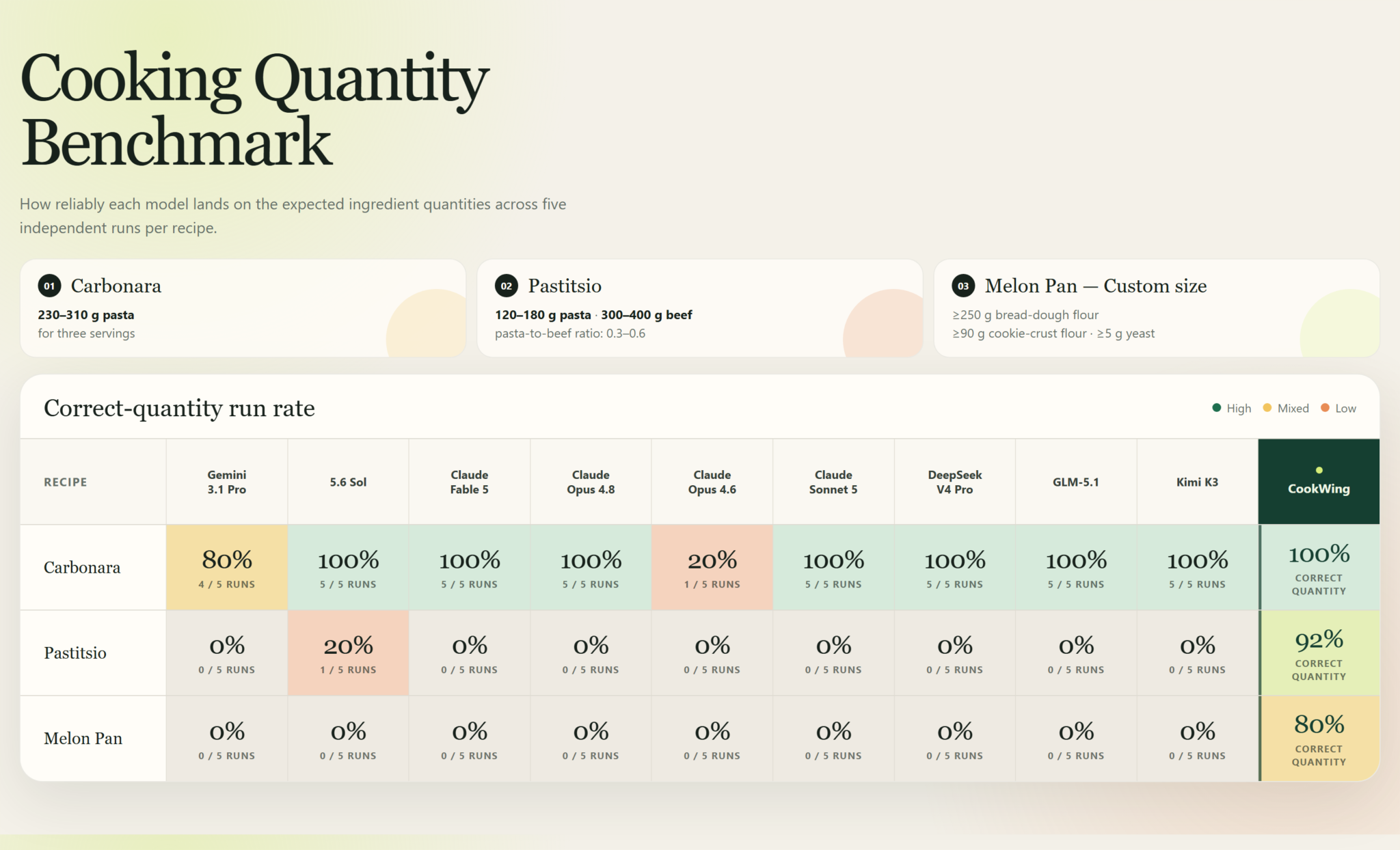
- Carbonara for three servings. The expected quantity is 230 to 310 g of pasta. This dish is extremely common on the web and in model training data.
- Pastitsio. The test expects 120 to 180 g of pasta, 300 to 400 g of beef and a pasta-to-beef ratio between 0.3 and 0.6. Each number must be plausible, but the numbers must also work together.
- Custom-size melon pan. The test requires at least 250 g of bread-dough flour, 90 g of cookie-crust flour and 5 g of yeast. The model must understand a two-dough recipe architecture and adapt it to a requested size.
The compared models are the ones named in the visual: Gemini 3.1 Pro, 5.6 Sol, Claude Fable 5, Claude Opus 4.8, Claude Opus 4.6, Claude Sonnet 5, DeepSeek V4 Pro, GLM-5.1 and Kimi K3. Their cells report correct runs out of five. The CookWing column reports the share of correct quantities produced by its anchored pipeline.
| Recipe | Nine general LLM configurations | CookWing |
|---|---|---|
| Carbonara | 40 correct runs out of 45 | 100% correct quantities |
| Pastitsio | 1 correct run out of 45 | 92% correct quantities |
| Melon pan | 0 correct runs out of 45 | 80% correct quantities |
Carbonara is a misleadingly easy test
On carbonara, seven of the nine configurations reach 100%. Gemini 3.1 Pro succeeds on four runs out of five, while Claude Opus 4.6 succeeds on one. In total, 40 of the 45 generations fall inside the expected range.
That finding matters because it prevents an overly simple conclusion. LLMs can often reproduce a popular quantity when a recipe appears extremely frequently in their data. A test made only of heavily documented dishes would make the problem look nearly solved.
But this success does not prove that a model understands a recipe. It shows that the model can recover a very common statistical association between a dish name, a serving count and a weight of pasta. Once a recipe requires a relationship between several components or an unusual size adjustment, the picture changes.
Pastitsio exposes the proportion problem
Pastitsio is more discriminating. A good version does not depend only on a pasta amount or a beef amount considered separately. Their ratio determines the structure of the dish, and that foundation must remain compatible with the sauce and béchamel.
In CookBench v1, eight of the nine configurations score 0% across five runs. Only 5.6 Sol succeeds once. That is a total of 1 successful run out of 45. CookWing reaches 92% correct quantities on this case.
The gap matches what happens in a real kitchen. A generated recipe may prescribe 500 g of pasta with an amount of beef sized for a much smaller dish. Each line looks possible. Together they make a pasta bake that carries the name pastitsio without preserving its balance.
Custom-size melon pan defeats every tested LLM
Melon pan adds two problems. The model must separate bread-dough flour from cookie-crust flour, then preserve enough yeast for the final mass. It is also a custom-size request, making an exact memorised example less likely.
The result is the clearest in the benchmark: zero successful runs out of 45 across the nine LLM configurations. CookWing produces 80% correct quantities. That score is not perfect, but it turns systematic failure into a largely usable result.
Across the two genuinely discriminating recipes, the general LLMs succeed once in 90 runs. Across all three recipes, they succeed 41 times out of 135, or 30.4%. That overall average is misleading, however: 40 of those 41 successes come from carbonara alone. The real difficulty appears once the benchmark moves beyond the most memorised dish.
Edible does not mean faithful to the recipe
A cooking hallucination does not always look absurd. The model does not necessarily write "12 kg of flour." It is more likely to suggest 450 g where 280 g was needed, or a plausible amount of meat that no longer matches the pasta ratio.
This is why the error survives all the way to the plate. The ingredients are edible, the instructions resemble a method and the cooking process produces something. But excess flour dries a crumb, too little yeast changes its structure, too much pasta dilutes the seasoning, and an incorrect sauce ratio erases the traditional flavour. The dish remains edible while ceasing to be what it claimed to be.
For a general assistant, a number is another piece of text. It can be statistically probable without coming from a specific recipe. Worse, several independently plausible values can be mutually incompatible. CookBench is designed to make that failure visible.
Why CookWing's anchoring changes the result
CookWing does not ask an LLM to invent an entire recipe from memory alone. Before generation, its quantity anchoring system runs a live search for a real, published reference recipe. It favours traditional sources written in the language of the cuisine: Italian for carbonara, Greek for pastitsio and Japanese for melon pan.
The pipeline then follows five concrete steps.
- It identifies the dish and its culinary tradition.
- It finds a relevant published reference in the original language.
- It extracts quantities, serving count and important ratios.
- It supplies those values to the model as an anchor table instead of asking it to guess.
- It scales the quantities for the requested table or size and rewrites the numbers inside the instructions too.
That final step matters as much as the lookup. Multiplying an ingredient list while leaving "add 200 g of flour" in the method creates a new contradiction. CookWing recalculates the list and the guided instructions together. We explain the same mechanism in more detail in our guide to recipe apps that automatically scale ingredient quantities.
Anchoring is not a magical guarantee. Scores of 92% and 80% show that errors remain to be removed. It does, however, change the nature of the starting point: quantities come from a published recipe, not an implicit average learned by the model. The results of this first version suggest that this change sharply reduces hallucinations on dishes that depend on real proportions.
What version 1 does not prove yet
Three recipes and five runs per model are not enough to declare a universal winner for AI-assisted cooking. CookBench v1 is a targeted test, not a measurement of every cuisine, every serving size or every quality of a recipe. It evaluates quantity ranges, not flavour in a blind tasting.
Model names and versions are also frozen at the time of the test. They will evolve. A future version would benefit from publishing the complete prompts, expanding the corpus across more countries, testing several serving counts, separating extraction from scaling, and having expected ranges reviewed by multiple cooks familiar with each tradition.
That caution does not erase the main signal. An easy benchmark would have said that every model can cook carbonara. Two more structural recipes instead produce 1 success in 90 general-model runs, compared with 92% and 80% correct quantities from the anchored system. That is what CookBench v1 establishes today, and what later versions should try to disprove.
You can browse hundreds of anchored dishes in the CookWing public recipe library, or read our analysis of AI recipe apps without quantity hallucinations. To test a dish you know by heart, download CookWing free on Google Play and compare the proportions, not just the prose.
FAQ
What is CookBench v1?
CookBench v1 is a targeted benchmark of quantity reliability in LLM-generated recipes. This first version compares nine configurations on carbonara, pastitsio and melon pan, using five independent runs per recipe and configuration.
Why does an LLM hallucinate cooking quantities?
An LLM generates the number that appears probable in context without necessarily retrieving it from a reference recipe. Several quantities may therefore look normal on their own while creating incoherent proportions together.
Does CookWing eliminate every quantity error?
No. CookWing scores 100%, 92% and 80% on the three displayed cases, leaving room for improvement. Its anchoring system nevertheless sharply reduces errors on the two recipes where the general LLMs fail almost systematically.
Where can I download the CookBench v1 benchmark image?
The original CookBench v1 PNG is available directly at 2048 × 1244 pixels. Open that standalone link to view or save the full-resolution image.